I’ve been wrestling a lot lately with how much to share of myself — and perhaps, more to the point, the people in my life — in the essays I write here.
On a recent drive back to New York after a family gathering, I started thinking about an essay on the Beatles. I had just finished reading Paul & John: A Love Story in Songs by Ian Leslie, a book that chronicles and assesses the relationship between Paul McCartney and John Lennon through the songs they wrote.
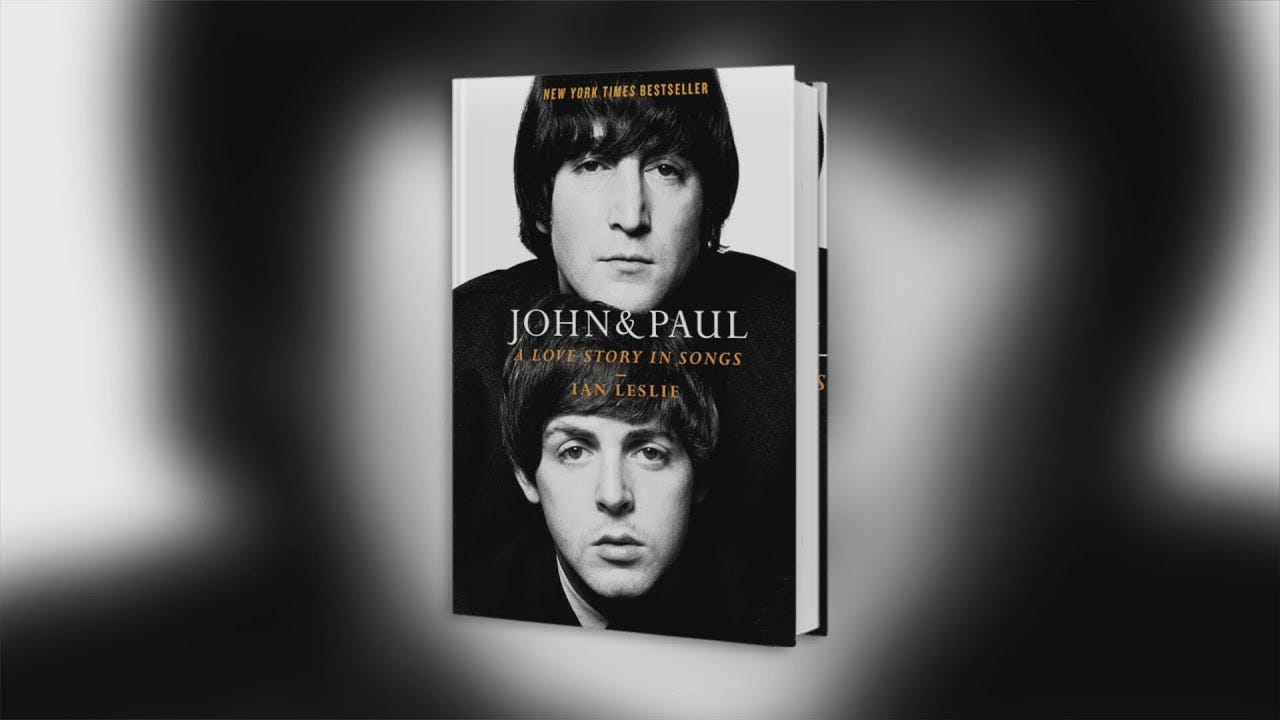
This was the latest chapter in my ongoing adult education and appreciation of the Beatles, which really only began in my forties.
Implicit in the telling of the Paul and John story, of course, is the exclusion of George Harrison, the bandmember to whom I had always gravitated the most. For many years, my devotion to George was almost in opposition to the whole idea of “The Beatles.”
So on that car ride, I started asking myself why that was. I always thought it was just because I liked George’s songs better, but that didn’t feel right anymore. I considered whether I gravitated toward George because we’re both the “little brother.” Did my place in my family play into how I felt about the Beatles?
But I didn’t pursue the idea.
Every family has its own dynamics, and I didn’t want to turn my relatives into characters in an essay I’d publish without talking to them first. (I also wasn’t confident my theory would hold up.)
Around that time, my therapist and I were discussing recurring thoughts that can be hard to escape.
“I have a shredder in the corner over there,” he said. “People write things down and share them here, then shred them and get on with their lives.”
Yet many of the artists we admire most are compelled to reveal themselves in their work, even when doing so complicates their personal lives.
A few days after shelving my Beatles idea, I stumbled upon two documentaries playing at Film Forum in the West Village that echoed the questions I’d been asking myself.
In the early 1980s, filmmaker Ross McElwee received a grant to retrace Gen. William Tecumseh Sherman’s devastating 1864 campaign through the South.
Before McElwee could make much progress, though, his girlfriend dumped him. He pushed forward on the project anyway. But as he followed Sherman’s path across the South, he discovered a more compelling story to film: his friends and family wanted him to find a wife.
I’ve long believed that every great documentary is ultimately about obsession. While Sherman’s March (1986) bears the wonderful subtitle, “A Meditation on the Possibility of Romantic Love in the South During an Era of Nuclear Weapons Proliferation,” it’s really about McElwee’s obsession with filming everything he encounters.
He’s rolling when he goes on first dates, when existential dread keeps him up at night, even when he interrogates an ex-girlfriend about whether she still loves him in the middle of a rally promoting the Equal Rights Amendment.
On several occasions, his subjects ask him to stop filming them, a request he doesn’t always honor (at least not in the finished film). At times, the awkwardness of these interactions made me squirm in my seat.
But in Sherman’s March, McElwee turns the camera on himself as relentlessly as he does everyone else, exposing his own insecurities. I think that’s why the film has resonated so deeply with viewers for four decades.
Yet for all its warmth and humor (I laughed out loud many times), I couldn’t stop wondering what it must have felt like to be one of the people in McElwee’s life. It’s one thing to document your own heartbreak. It’s another to enlist everyone around you in the story, whether or not they signed up for that.
I returned to Film Forum the next day to see McElwee’s most recent film, Remake (2025), which spends a bit of time on a Hollywood producer’s attempts to turn Sherman’s March into a fictional movie.
But McElwee’s true subject in Remake is his son, Adrian. He had filmed snippets of Adrian’s life since birth, often using that footage in his films.
In Remake, McElwee revisits his 2011 film Photographic Memory, in which he depicts Adrian in his early twenties as unfocused, distracted by technology, and beginning to struggle with drugs and alcohol. Their relationship becomes strained, causing McElwee to reexamine his own life as a young adult.
Then came silence.
He didn’t make another film for 14 years. When he returned with Remake, Adrian was gone. He died at 27 after years of addiction and mental illness.
Remake becomes McElwee’s reckoning with the cost of putting people he loves in his art. He questions whether, by documenting and sharing his son’s struggles with the world, he added to Adrian’s pain, perhaps even hastening his demise.
But I found it almost impossible to imagine him doing anything differently. For him, filming what he sees and sharing those images with the world seems as essential as breathing.
On my walk home from the theater, I thought back to my therapist's shredder. Sometimes writing something down is enough. Not every truth needs an audience.
Yet if McElwee had chosen the shredder instead of the camera, we wouldn't have Sherman's March. We wouldn’t have Remake. We wouldn’t see an artist struggling with the bargain he made, leaving me still wondering where I should draw the line.